
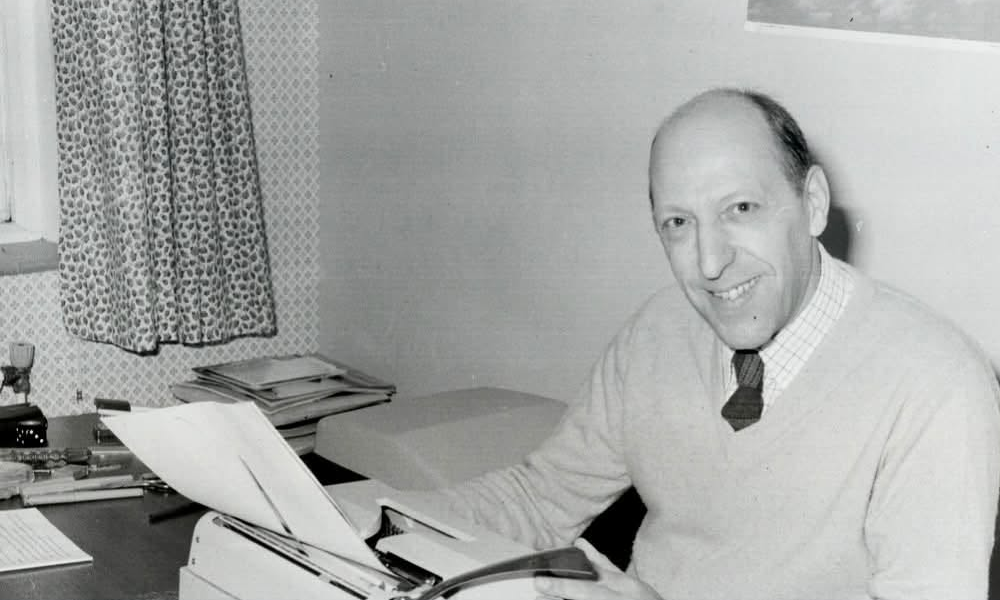
There was a time when a young football fan looking for something to read was quite likely to come across the name Michael Hardcastle.
His books filled school libraries and children’s shelves for decades. Football was his great subject, although cricket, horse racing, motor racing and other sports all found their way into an extraordinary writing career of more than 140 books. His stories were fast, accessible and written for children who might have been rather more interested in Saturday’s match than Monday’s English lesson.
What is less widely appreciated locally is that this nationally successful children’s author made his home in Beverley.
Hardcastle lived for many years in Molescroft Park, and Beverley remained his home until his death in January 2019. The official notice following his death records him simply and rather wonderfully as: “Molescroft Park, Beverley… Author.”
He had been rather more than that.
Hardcastle was one of Britain’s most prolific writers of children’s sports fiction, a former journalist whose books reached generations of young readers. In 1988, his contribution was recognised when he was appointed MBE for services to children’s literature.
For Beverley, his story is another reminder of the remarkable people who have sometimes lived and worked quietly among us.
A Yorkshire childhood
Michael Hardcastle was born in Huddersfield on 6 February 1933 and attended King James’s Grammar School at Almondbury.
There is an appealing irony to the childhood of the man who would eventually become synonymous with children’s sports books.
Hardcastle wasn’t much of a sportsman.

It wasn’t through lack of enthusiasm. Childhood illnesses, including scarlet fever and rheumatic fever, meant his school considered him too physically fragile for contact sports.
While other boys headed for the playing fields, Hardcastle was dispatched to the library.
It could hardly have worked out better for British children’s publishing.
He became a voracious reader, consuming the adventures of W.E. Johns and later Charles Dickens. But Hardcastle noticed something missing. For a boy interested in sport but unable to participate in it, there was surprisingly little sports fiction available in book form.
There were sporting adventures in comics, but relatively few novels capable of providing the same experience.
Years later, Hardcastle would effectively write the books he had wanted to find on those library shelves as a boy.
From newspapers to novels
Writing did not immediately mean children’s fiction.
After school and service in the Royal Army Educational Corps, Hardcastle entered journalism and worked for provincial daily newspapers.
His career included a spell as literary editor of the Bristol Evening Post from 1959 to 1965, followed by two years as chief feature writer at the Liverpool Daily Post.
That newspaper background helps explain something about the books that followed.
Hardcastle wasn’t interested in endlessly decorating a sentence. His stories moved. Characters had problems to solve, matches to play and decisions to make. The reader was expected to keep turning the pages.
In 1966 he published his first children’s novel, Soccer Is Also a Game, later republished as Soccer Comes First.
It introduced Scorton Rovers, a fictional struggling football club, and began the career that would define him.
A year later came Shoot on Sight, Redcap and Aim for the Flag. By the 1970s, Hardcastle’s output had become formidable.
Titles such as Goal, Strike, In the Net, United!, Free Kick, Heading for Goal, The Match, The First Goal, On the Ball and Goal in Europe leave relatively little doubt about where many of his interests lay.
He was building a body of children’s football fiction on a scale few British writers had attempted before him.
Football stories with something underneath
Calling Hardcastle a writer of football books is accurate, but doesn’t quite explain why the books lasted.
Football provided the setting. The stories could be about rather more.
United!, published in 1973, follows a struggling youth football team whose players decide to pay £1 to recruit a talented player from a rival side. His arrival improves their prospects but raises questions about loyalty, friendship and what winning is worth.
Half a Team, published in 1980, takes two young players rejected by their respective teams and has them form another side to prove themselves. Again, football provides the action, but rejection, resilience and belonging provide the story.
That became characteristic of Hardcastle’s work.
There were goals and cup ties because that was what his readers wanted. Around them he could write about ambition, disappointment, friendship, bullying, family relationships, responsibility and the pressure placed on young sportsmen.
A later work, The Price of Football, dealt with the physical toll the game can take on players.
Hardcastle understood something publishers now discuss endlessly under headings such as “reluctant readers”: children are more likely to read when you give them stories about things they already care about.
He had worked that out decades earlier.
Far more than football
The sheer quantity of Hardcastle’s work is striking.
More than 140 books are attributed to him, with his bibliography stretching across more than three decades.
And despite becoming particularly associated with football, he refused to remain confined to it.
Horse racing appeared in books such as The Saturday Horse, The Switch Horse and Winning Rider. Cricket produced titles including The Demon Bowler, Caught Out and The Fastest Bowler in the World.
There were books involving cycling, fishing, motor racing and other sports, alongside stories that ventured considerably further from the touchline.
He even wrote under another name. A series of books including Goalie, Splash, Run, Top Spin, Grab, Winner and Volley appeared under the pseudonym David Clark.
This was not an author who stumbled across one successful football series and spent the rest of his career repeating it.
Hardcastle had found a field of children’s literature in which there was enormous scope for storytelling, and he explored it relentlessly.
An MBE for children’s literature
By the 1980s, Hardcastle’s contribution to children’s writing was well established.
Then came national recognition.
The 1988 Birthday Honours appointed Michael Hardcastle MBE. The official description was admirably straightforward: “Writer of Children’s books.”
He was recognised for his services to children’s literature.
It is worth dwelling on that description because Hardcastle’s achievement can easily be underestimated precisely because his books were so accessible.
These were books children could simply enjoy.
For generations of young readers, particularly football-mad boys who might not naturally have reached for a novel, that mattered enormously.
Hardcastle also travelled to schools and colleges around Britain talking to children about books and writing.
The boy who had been sent to the school library because he couldn’t join his classmates on the sports field had ended up helping another generation find their own way into books.
Michael Hardcastle and Beverley
And eventually this substantial literary career became part of Beverley’s story.
Hardcastle made his home in Molescroft Park and remained in Beverley until his death.
That connection deserves more local attention.
Beverley quite rightly celebrates its long cultural history. We remember the medieval minstrels, the artists Fred and Mary Elwell and the writers and performers associated with the town.
Hardcastle belongs to a more recent chapter of that tradition.
His subject matter was rather different. There were fewer drawing rooms and landscapes and considerably more muddy football pitches.
But his reach was substantial.
Search second-hand bookshops today and the covers themselves form a little history of British children’s publishing: footballers in gloriously 1970s kits, dramatic tackles, goalmouth scrambles and titles designed to be irresistible to a child wandering through a school library.
Those battered old paperbacks also tell us something about the kind of literary success Hardcastle achieved.
His books were read.
They were borrowed from libraries, passed between children, taken to school, reprinted and returned to by successive generations.
A writer worth remembering locally
Michael Hardcastle died on 17 January 2019, shortly before what would have been his 86th birthday.
By then children’s publishing had changed enormously from the world in which Soccer Is Also a Game appeared in 1966.
Football itself had changed beyond recognition.
Yet the central idea behind Hardcastle’s writing looks remarkably modern: start with something a young person genuinely cares about and use it to draw them into reading.
He didn’t regard popular subjects as somehow beneath children’s literature. Football, racing and cricket were gateways into stories about people.
There is also something pleasingly Yorkshire about the trajectory of his life.
A Huddersfield schoolboy prevented from playing sport spends his time reading instead. He becomes a provincial newspaper journalist, spots a gap in children’s books and starts writing the sporting stories he couldn’t find when he was young.
One book becomes another.
Then another.
Eventually there are more than 140 of them.
An MBE follows.
And for many of those years, one of Britain’s most prolific children’s writers was living here in Beverley.
Michael Hardcastle isn’t a forgotten author, and describing him that way would diminish a career that reached too many readers to justify it.
Perhaps the more interesting question is whether Beverley has properly claimed him as one of its own.
His books were once familiar sights in children’s bedrooms and school libraries across Britain. His contribution to children’s literature was recognised by the Crown. His career stretched from the age of the football pools and muddy First Division pitches into the era of the Premier League.
And behind that enormous shelf of books was a writer who called Beverley home.
That seems well worth remembering.