
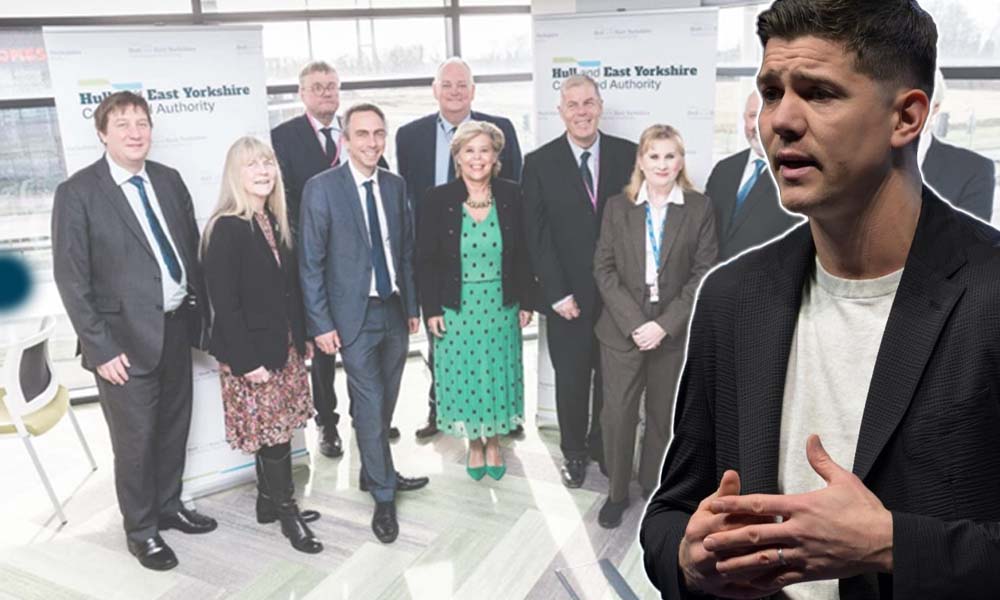
BEVERLEY – Beverley Review has examined the formal record of the Hull and East Yorkshire mayoralty to understand what has been done, what is underway, and how effective the new role has been so far.
Our report is based on a through reading of Executive Board agendas and minutes of the Hull and East Yorkshire Combined Authority, recorded mayoral statements, responses to public questions, published decisions, and official press releases issued during the mayor’s first nine months in office.
We have focused on actions that have been formally agreed, funding that has been secured or allocated, and activity that has progressed beyond intention into delivery.
Where plans remain in development, or where activity is described as ambition or lobbying rather than outcome, that distinction is made clear.
Nine months after taking office, Luke Campbell is no longer in the grace period afforded to a new role. The Combined Authority is operational, its governance is largely in place, and there is now enough evidence in the public record to assess early effectiveness.
Campbell assumed office in early May 2025 as the first Mayor of Hull and East Yorkshire, inheriting a newly created authority with limited but clearly defined powers over transport, skills, investment and regional representation. His early months have therefore combined institution-building with the first signs of policy direction.
The clearest area of progress has been governance and funding control. Within weeks, the Combined Authority accepted its annual transport settlement and agreed how both capital and revenue funding would be handled. Revenue funding was retained centrally to support transport capability, while capital allocations were passed to Hull City Council and East Riding of Yorkshire Council. These were not new investments, but they demonstrated that the new authority was functioning as intended.
Skills devolution also moved forward. The Combined Authority approved and submitted its Adult Skills Fund readiness approach, incorporating amendments to support disadvantaged learners, ESOL provision and work within custodial settings. While this did not immediately change provision on the ground, it placed control of skills funding within the region and met government requirements.
Less successful, investment policy has so far been preparatory rather than decisive. Rather than adopting a full investment plan, the authority agreed a set of investment principles to guide future decisions.
These principles were amended to include transport safety and collaboration across the Humber, but a detailed investment plan remains in development. Local councillors and others have raised questions over the delay and Hull Labour Party recently issues a press release saying the hesitancy could cost jobs though there is no evidence of this so far.
Transport has dominated mayoral statements and updates. Luke has reported meetings with bus operators and rail providers, describing improved data-sharing and the establishment of route-level performance monitoring. These actions suggest a willingness to engage with operators, but no again, no formal service changes or binding performance targets have yet been agreed.
Rail electrification has been a repeated ambition throughout the period. Mayor Campbell has raised the issue in regional and national forums and positioned it as a long-term priority. At this stage, however, the record shows advocacy rather than secured funding or commitments, though this could change in the coming months as, like other authorities he begins to looks to look at potential private investment in rail.
Housing has been framed as a future opportunity rather than a delivered outcome. Luke has stated his intention to unlock around 5,000 homes on brownfield sites, but no site-specific approvals or funding decisions have been recorded within the first nine months.
Environmental policy has produced a tangible outcome: £700,000 secured for solar installations on public buildings across Hull and East Yorkshire. Beyond this, the mayor has emphasised job creation and deliverability when responding to questions about green energy, rather than setting out a comprehensive regional strategy. He has surprised many by straying on this matter from the official Reform UK party line.
Industrial intervention has been limited to lobbying. The Combined Authority has written to central government and the Prime Minister regarding bioethanol production and trade impacts affecting a major local employer. These actions are recorded, but no outcomes are yet evident.
Taken as a whole, the first nine months show a mayoralty that has been effective at establishing structures, securing existing funding, and positioning the region in national discussions. Delivery of new projects, however, remains limited, with most major initiatives still in planning or development.
On balance, the urgency of economic development could have been met with greater pace, particularly given ongoing pressures around employment, investment and long-term productivity across Hull and East Yorkshire. That said, after years of public disillusion with recycled announcements, headline-driven initiatives and short-term schemes that fail to translate into lasting change, some may welcome a slower, less glitzy approach focused on method, preparedness and institutional credibility.
The challenge for the mayoralty will be ensuring that caution and groundwork do not become substitutes for delivery, as the second year of the role moves from planning into measurable outcomes.
The next phase will determine whether the role moves from coordination and advocacy into measurable change.