
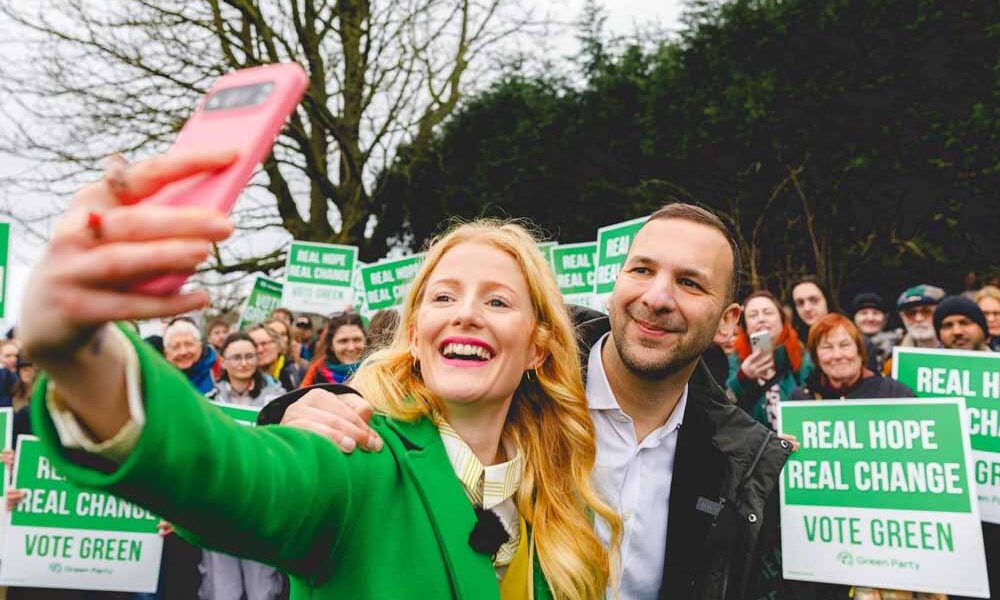
Main photo credit: The Green Party
BEVERLEY – This week’s breakthrough by the Green Party in the Gorton and Denton bi-election has naturally triggered speculation among political commentators about the rapidly changing political scene. The main question is this: is it a local, bi-election blip or the start of something more? A transformation on the left of British politics, mirroring what has allready happened on the right? Could the next election in 2029 (or earlier) actually be Greens versus Reform rather than Labour versus Conservative?
There is a poll in today’s Daily Express suggesting the Green Party is no longer confined to the margins and is drawing greater national support. In several seats the Greens seem to be threatening to replace Labour, who are struggling to identify, let alone appeal to parts of their traditional base.
Here in Beverley and Holderness, Graham Stuart held the seat in 2024 with 34.5 per cent. Labour finished on 34.2 per cent. Reform UK secured 18.3 per cent. The Liberal Democrats took 7.5 per cent. The Green candidate polled 3.7 per cent. Labour almost won.
If the national story does become the Greens taking chunks out of the Labour vote, then even a small rise in their local vote could have consequences for the shape of politics in Beverley and Holderness. But would it deliver a Green victory here?

That would require a surge even greater than that Reform have been recently enjoying to make the numbers add up. What a significant increase in the Green vote could do, however, is fragment the anti-Conservative vote in a seat already decided by a few hundred ballots. It could even strengthen the Conservative position.
A Green climb to eight or ten per cent, drawn largely from Labour voters, would not put the Greens in first place. It would likely make the Conservative hold more comfortable. That is the arithmetic as of now. But, things can change fast as we have seen.
There are caveats, of course. Few can doubt that British politics is on it’s own magic mushroom trip at the moment (something the Greens would make legal) and nobody can confidently predict when it will come down and where it will settle. Electoral loyalties are weaker than they were, and shifts that once took a decade can now occur in a single electoral cycle or less.

There are also some soft factors to consider. The Gorton and Denton result occurred in a very different environment: urban, younger, denser, with a sizeable student presence. Beverley and Holderness is older, more rural and socially distinct. It does not share the demographic profile that has powered Green advances elsewhere. There is also a well-known and popular long-time sitting MP in Graham Stuart who has defined all electoral cycles and turmoil of the past twenty years – the finical crash, austerity, Brexit, Covid and has continued to hold the majority support of locals and worked away for their general benefit.
Yet there are local pressures that give the Greens a platform. Beverley continues to wrestle with housing expansion, infrastructure strain and questions about the town’s character. Development on the edges of the town is visible and contentious. On planning restraint, green space and environmental protection, the Green message can resonate beyond its traditional base.
The difficulty is scale. Moving from 3.7 per cent to something north of 30 per cent would require a collapse of Labour, a failure of Reform to absorb protest voters and a dramatic reshaping of local voting habits. That is not impossible in politics. It is simply improbable on present evidence.
Could Beverley and Holderness go Green? In the near term, no. What is more plausible is a different outcome: the Greens growing enough to influence who wins, without coming close to winning themselves. In a marginal seat, that may matter more than the headline.