
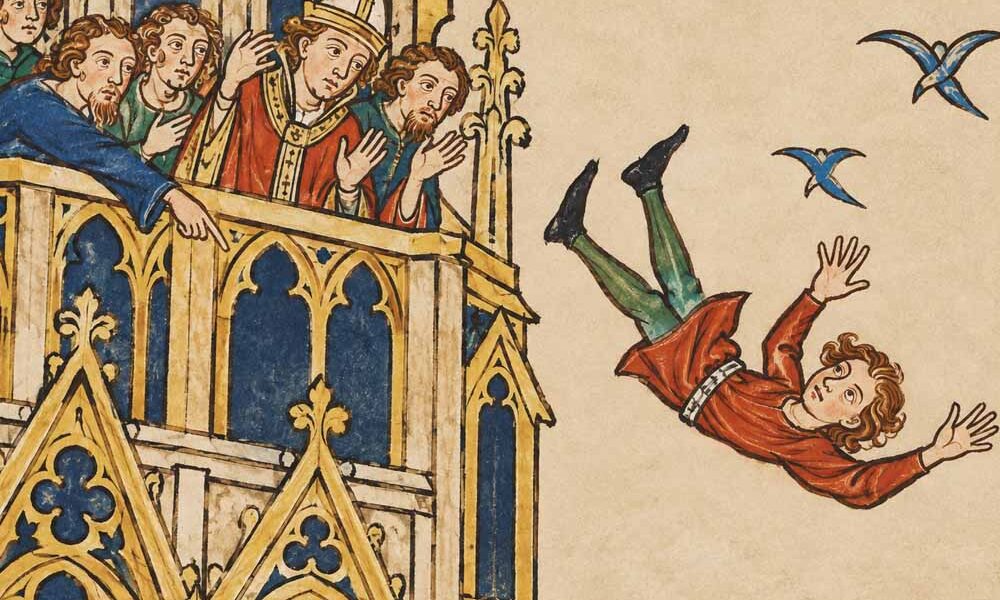
More than 800 years ago, a boy climbed high inside Beverley Minster to get a better view of a religious play. He fell into the church below and was believed to be dead. According to a medieval account that survives to this day, he then got back up.
There is a legend about a Beverley boy who fell from the Minster and came back to life. Except it turns out the legend is real. Or, more precisely, the medieval account of it is real.
The extraordinary story was recorded more than 800 years ago and survives in a medieval manuscript. It has since been studied by historians and is included in the modern Cambridge Anthology of British Medieval Latin, published by Cambridge University Press.
What happened to the boy cannot now be independently established. Nobody in the 13th century was checking a pulse with an Apple Watch. But we can get surprisingly close to the story that people in medieval Beverley actually told, because the surviving account contains an extraordinary amount of detail.
It begins around the year 1208, with a huge crowd gathered outside Beverley Minster to watch a play.
The crowds gather at Beverley Minster
The performance was taking place in the Minster churchyard and depicted the Resurrection of Christ. The medieval account describes masked or disguised performers taking part and says a great number of spectators had gathered to watch.
That created a problem for a group of boys who had come to see the spectacle. Unable to get a satisfactory view through the crowd, they went inside the Minster and climbed upwards towards the vaulting. Eventually they reached a window high in the building from which they could look down upon the performance outside.
For a few moments at least, they must have had one of the best views in Beverley. Then the church wardens noticed them.
According to the account, the wardens were worried that the boys might damage the window and went up after them. Their intention appears to have involved rather more than politely asking them to come down: the account says the boys were punished for their recklessness, with blows being inflicted on those who were caught.
One boy managed to avoid them and ran further up the stairs.
The fall
As the boy scrambled away, his foot loosened a stone. It fell from the height of the building and crashed onto the pavement far below. The sudden noise startled him, causing him to lose his balance and fall too.
The boy plunged into the nave of the Minster and landed on the floor below. The surviving account describes him lying there apparently dead.
There were people inside to see what had happened. Some members of the crowd had apparently entered the church because there were so many spectators outside, and they now gathered around the fallen boy.
What they believed happened next is the reason we know anything about him more than eight centuries later. The boy recovered and rose.
According to the account, he showed no mark of injury from his fall. The medieval writer presents what happened as a resurrection and a miracle associated with St John of Beverley. The boy’s recovery was described as taking place publicly, in front of those present.
For the people who recorded the story, however, there was an even more remarkable coincidence.
A Resurrection outside and another inside
While all this was happening, the people outside Beverley Minster were watching actors perform the Resurrection of Christ.
Those who had gone inside because they could not see the performance had therefore missed the theatrical resurrection in the churchyard. Instead, according to the medieval writer, they had witnessed a sign of the Resurrection for themselves when the apparently dead boy recovered inside the Minster.
It is a striking piece of medieval storytelling, but it is also important to understand what sort of source we are dealing with.
The account survives among stories of miracles associated with St John of Beverley. The version studied by academics forms part of material appended to the medieval Life of St John of Beverley. The manuscript tradition containing the account survives in a Beverley cartulary now held by the British Library, and the episode has been studied in detail by historians of medieval religion and drama.
The Cambridge Anthology of British Medieval Latin summarises the same essential sequence: a boy wanting to watch a religious drama climbed high inside the Minster, fell to the paving below, appeared to be dead and subsequently returned to life. The medieval account explicitly connects his apparent death and recovery with Christ’s death and Resurrection.
Did a boy really come back from the dead in Beverley?
This is where the history and the miracle need to be separated.
There is no way of knowing whether the boy was actually dead. Medieval observers did not have modern medical methods for determining death, and the account was written as a record of a miracle rather than as an investigation of an accident.
He may have been unconscious or stunned. The height and precise circumstances of his fall cannot now be reconstructed sufficiently to tell us what injuries we would expect him to have suffered. It would therefore be going considerably further than the evidence allows to report as historical fact that a child died and was resurrected.
What is historically documented is extraordinary enough. A medieval source records that boys climbed high inside Beverley Minster while a religious performance was taking place outside; wardens pursued them; one boy dislodged a stone, was frightened by its crash and fell into the nave; witnesses apparently thought him dead; and the boy recovered.
Those who witnessed or subsequently recorded the event attributed his survival to St John of Beverley.
There is another reason historians are interested in the story. The performance taking place outside provides unusually early evidence for drama in Beverley.
Beverley was staging plays 800 years ago
Academic Patricia Badir has examined the episode in the journal Theatre Survey, dating the account to around 1208 and exploring what it reveals about the relationship between religious ritual, theatrical performance and medieval ideas about miracles.

That puts the scene roughly 350 years before Shakespeare was born.
It also gives us something more interesting than a date in the history of theatre. The medieval writer inadvertently preserved a snapshot of life in Beverley at the beginning of the 13th century.
There was a large public event in the town. Performers were acting before a packed audience in the churchyard. People were struggling to see. Some went inside to escape the crowds, while a group of boys decided that climbing high into the Minster was the obvious solution to their problem.
The church authorities spotted them and gave chase. One boy, faced with the prospect of being caught, went higher rather than surrendering and very nearly paid for it with his life.
The language, clothes and buildings belonged to another world, but the behaviour of the children requires considerably less historical explanation.
Somewhere around 1208, one very lucky Beverley boy walked away from a fall that the people watching him believed should have killed him. They remembered it as a miracle, and more than 800 years later their account of what happened survives.
In 1208 the nave of the current Minster wasn’t yet constructed so this must have taken place in the Norman church which had been badly damaged by fire in 1188. This may account for the boys being able to climb up and a loose stone(Ashler) block being loose.