
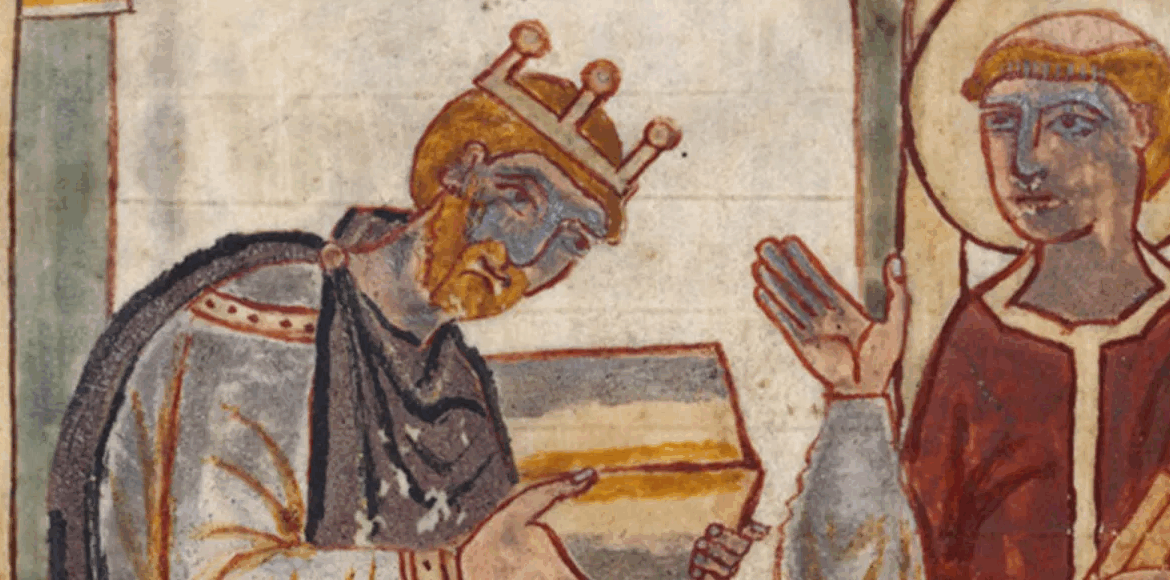
BEVERLEY – In the long story of Beverley, one episode has echoed for centuries. The day tradition says that King Athelstan came here in the tenth century to pray before a decisive battle and in doing so helped shape the town we know today.
The year was 937, or possibly a little earlier in the 930s. Athelstan, widely regarded by historians as the first king to rule all of England, was campaigning in the north. Before facing the combined forces of Scots and Norse at what would become known as the Battle of Brunanburh, tradition holds that he paused in Beverley to seek help at the shrine of St John of Beverley, in the church that stood on the site long before the great Gothic Minster we see today.
The precise historical details are uncertain. The earliest written accounts of this royal visit appear centuries later, recorded by medieval clerics who were often as interested in legend as in fact. What is clear, however, is that by the Middle Ages Beverley’s association with Athelstan had become central to the town’s identity.
According to that tradition, the king prayed at the tomb of St John before the battle and afterwards credited his victory, at least in part, to the saint’s intercession. In thanksgiving, Athelstan is said to have endowed the church, granted it special privileges and, most importantly, conferred the right of sanctuary. This was a powerful legal protection that made Beverley one of only a small number of places in the north of England where fugitives could seek refuge.
Sanctuary was not simply a symbolic idea. It was rooted in medieval theology and law, which held that sacred spaces offered divine protection and were therefore inviolable. In Beverley, this belief left physical traces that can still be seen today. The frith stool, a carved stone seat inside the Minster, marked the place where those seeking sanctuary would sit, while the sanctuary stones once marked the outer boundary of the protected area around the town.
St John of Beverley himself was already an important figure long before Athelstan’s reign. A bishop of York in the early eighth century, he retired to a monastery here and was later canonised. By the early tenth century, Beverley had become a place of pilgrimage, making it a natural stopping point for those seeking spiritual aid or protection.
Whether Athelstan personally laid down his sword at the shrine or carried St John’s banner into battle remains open to debate. The Anglo Saxon Chronicle does not mention Beverley directly, and the surviving charters linked to Athelstan exist only in later copies whose authenticity is uncertain. But the absence of definitive proof does not diminish the importance of the story.
What matters is that Beverley believed it, and that belief shaped the town’s development.
In the centuries that followed, other monarchs visited Beverley Minster to honour St John. Medieval records list a succession of royal visitors, and the shrine continued to attract devotion from across the country. Even Henry V later associated his victory at Agincourt with the saint’s intercession and visited the Minster in thanks.
The legacy of this early medieval moment is still visible today. The Minster itself, one of the largest parish churches in Europe, owes much of its prominence to its origins as a pilgrimage centre. The frith stool remains quietly in place, a reminder of a time when mercy, law and faith intersected. The line of the old sanctuary stones still hints at a landscape once shaped by the idea of refuge.
The legal right of sanctuary eventually disappeared, brought to an end during the upheavals of the Reformation and later abolished altogether. Yet Beverley’s place in that history remains distinctive.
So what should we make of Athelstan’s visit now. On one level, it is a blend of faith, legend and history. On another, it reveals how communities construct meaning through memory. Beverley chose to remember Athelstan here, and by doing so anchored its identity to a moment when royal power and spiritual authority met.
Nearly eleven centuries on, the story still matters. Not because every detail can be proven beyond doubt, but because it tells us something lasting about Beverley itself and about the way belief and history combine to shape the places we live in.
Timeline:
Early 700s
John of Beverley serves as Bishop of York and later retires to a religious community in Beverley. After his death, the site becomes a focus for devotion and pilgrimage.
1037
John of Beverley is formally canonised, strengthening Beverley’s reputation as a holy place and increasing the number of pilgrims visiting the town.
Early 930s
Beverley is already an established religious settlement with a stone church and a growing community built around the cult of St John.
c. 937
King Athelstan campaigns in the north of England. Tradition holds that he visits Beverley to pray at the shrine of St John before the Battle of Brunanburh.
937
The Battle of Brunanburh takes place, with Athelstan defeating a combined force of Scots and Norse. It is regarded as one of the most important battles in early English history.
Mid to late 10th century
According to tradition, Athelstan grants Beverley special privileges, including the right of sanctuary, allowing fugitives to claim protection within the town’s boundaries.
11th to 15th centuries
Beverley grows as a major pilgrimage centre. Kings and nobles visit the shrine of St John, and the Minster is expanded and rebuilt over successive generations.
1415 to 1420s
Henry V associates his victory at Agincourt with the intercession of St John of Beverley and later visits the Minster in thanksgiving.
16th century
The right of sanctuary is effectively ended during the Reformation, as church privileges are reduced and religious practices change.
Today
Beverley Minster remains one of the largest parish churches in Europe. The frith stool and traces of the sanctuary stones continue to mark the town’s unique place in medieval history.