
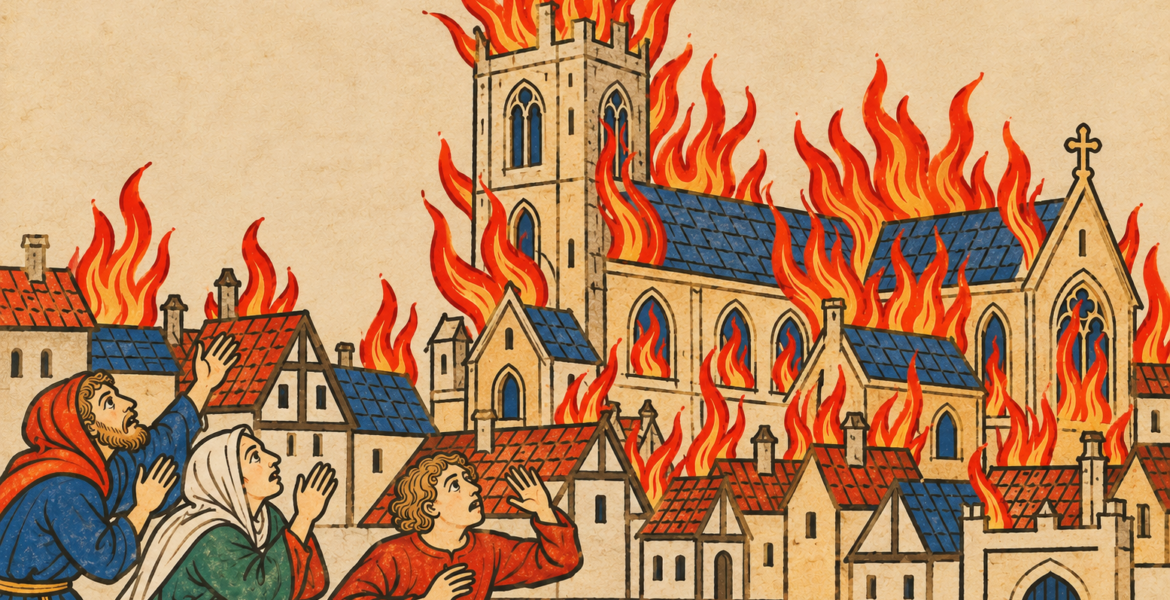
Imagine Beverley on a September night in 1188. There were no streetlights, no fire engines and certainly no emergency service capable of dealing with what was about to happen. The town would have been dark except for candles, lamps and domestic fires burning inside buildings constructed largely from materials that made fire a constant danger.
At its heart stood the great church of St John of Beverley. It was not the Minster we know today, but an earlier Romanesque building. Beverley was already an important religious centre, with pilgrims coming to the shrine of St John for generations, while the settlement that had grown around his monastery was becoming an increasingly prosperous medieval town. Beverley Minster’s own history records that by 1188 the town was already wealthy, both from pilgrimage to St John’s tomb and from the wool trade.
Then, in 1188, Beverley caught fire. This is no local legend embellished over eight centuries. The fire was recorded by Roger of Howden, one of the great English chroniclers of the period. Modern research into the building history of Beverley Minster describes his account as recording the Minster burning along with much of the town.
In a medieval town containing large quantities of timber and thatch, fire could move with terrifying speed. There were no pressurised water supplies or organised fire brigades to stop it. Once a large blaze had taken hold, people could do little more than carry water, rescue possessions and desperately try to prevent the flames reaching the next building.
The church of St John was severely damaged. Beverley Minster’s official history describes the east end as having been damaged by the fire, while Historic England records the Romanesque church as being “severely damaged” and subsequently extensively rebuilt. For the people watching it happen, this must have been an extraordinary sight. This was more than simply the town’s largest building. It contained the shrine of the saint around whom Beverley itself had grown and whose reputation had made the town an important destination for pilgrims.
Remarkably, centuries later, another record of the disaster emerged from inside the Minster. When St John’s tomb was opened in 1664, a lead plaque was discovered bearing an inscription recording that the church had burned in September 1188. The inscription also recorded a search for St John’s relics in 1197, when bones were found and reinterred. Modern archaeological research into the Minster uses this inscription alongside Roger of Howden’s chronicle as evidence for the fire.
What happened next would eventually transform Beverley.
According to Beverley Minster, construction of the present Gothic church began at its east end around 1190, only a couple of years after the fire. Recent research published in the Journal of the British Archaeological Association supports the argument that Gothic rebuilding began soon after the 1188 disaster, rather than decades later as historians once believed.
The story was not straightforward. In the early 13th century the tower over the eastern crossing collapsed, ruining the east end and requiring another major rebuilding campaign. The Minster then continued to evolve over generations, with the medieval craftsmen eventually producing the enormous Gothic church whose towers still dominate Beverley’s skyline.
Look closely inside the present building, however, and there may still be a survivor from the Beverley that existed before the flames.
The ancient Frith Stool, or Chair of Peace, is the oldest object in the Minster and dates from the Anglo-Saxon period. Beverley Minster says it is reasonable to assume that the chair was moved into the Romanesque church begun around 1160 and survived the fire of 1188. Visitors today may therefore stand beside an object that was already in Beverley when the disastrous fire swept through the town more than eight centuries ago.
Today it is difficult to imagine Beverley without the Minster. Its towers appear above the rooftops from almost every approach to the town, and the building feels so permanent that it is tempting to think it has simply always been there. Its history is considerably more dramatic.
In 1188, a great fire swept through Beverley and seriously damaged the church at its heart. Roger of Howden recorded it, an inscription discovered centuries later preserved its memory, and archaeological research continues to reveal what happened afterwards.
The Gothic rebuilding that followed the disaster became part of a much longer construction story involving collapsed towers, successive generations of craftsmen and centuries of architectural change. The result is the Beverley Minster we recognise today.
So the next time you walk into the Minster, spare a thought for the Beverley residents who saw its predecessor burning more than 800 years ago. They could hardly have known that from that disaster would eventually emerge one of the finest medieval churches in England.