
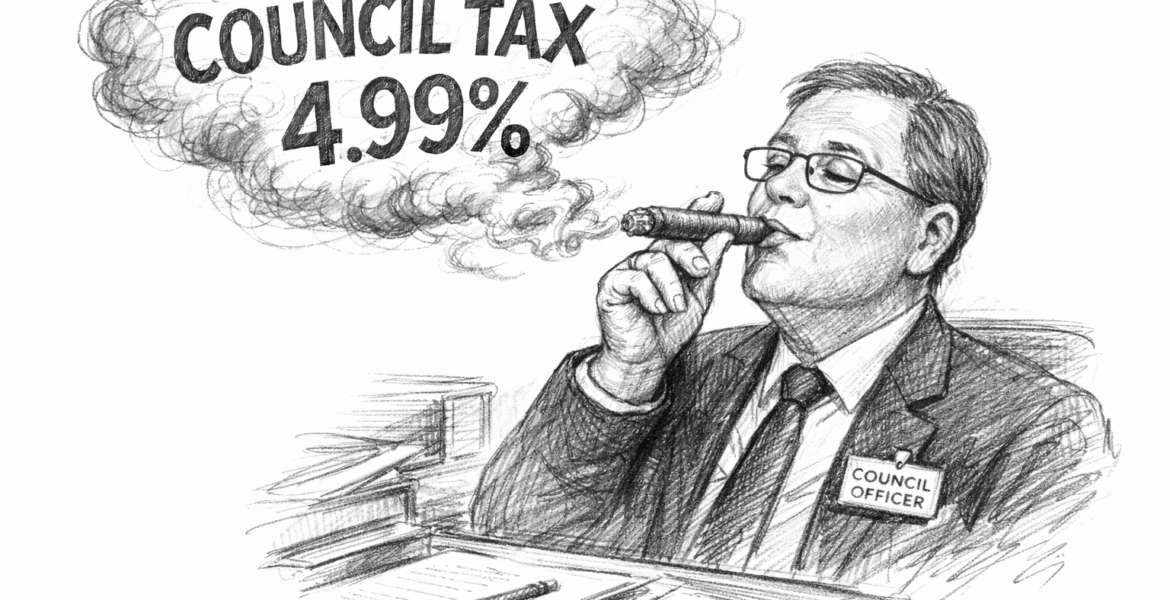
EAST RIDING – Council tax rises have become routine in the East Riding, justified year after year by the same familiar pressures. But beneath the language of funding cuts and rising costs lies a deeper issue that all councils struggle to confront.
East Riding Council has approved another business and financial plan built on a familiar assumption: council tax will rise again.
The explanation rarely changes. Government support has reduced. Costs are rising. Demand for services continues to grow. All of that is true. Anyone who has spent time looking seriously at local government finance understands the scale of the challenge councils now face.
But after more than a decade of near-continuous council tax rises, those explanations no longer tell the whole story. They explain pressure. They do not explain why higher bills have become the council’s default response.
Council tax has risen in the East Riding in good times and bad. It rose when inflation was low. It is rising again now inflation has bitten. Different leaders, different strategies, different slogans. The outcome remains the same.
At some point, a response to circumstance begins to look like a habit.
The newly approved plan talks at length about transformation, prevention and long-term sustainability. What it does not clearly demonstrate is whether the same intensity has been applied to improving the council’s own ways of working as has been applied to increasing household bills.
From inside local government, the pattern is a familiar one. A budget gap emerges. The pressures are set out. Council tax quietly becomes the balancing item. The harder questions about efficiency, value for money and organisational performance are acknowledged, but rarely pursued with the same urgency.
As a former councillor involved in scrutiny, I know how hard officers at East Riding work. Not just in delivering services, but in planning budgets under extraordinary pressure. We are fortunate to have them. But it is a large, complex organisation, and the levers of change are often difficult to find, let alone pull. I have seen how easily this becomes overwhelming, and how quickly a council tax-first mindset can become normalised. Once that happens, tax rises stop feeling like a choice and start being treated as inevitable.
This time around, politics at Westminster is different. There is a Labour government in Westminster so the responsibility for Conservative lead East Riding can naturally be binned off onto them. This is of course a fact, central government support has significantly shrunk but it was not part of the explanation during previous tax rises during previous Conservative governments. Besides which, central government money is also our tax money too – a point lost on many local councils when they point to government funding problems.
If East Riding Council genuinely wants to reduce its reliance on council tax, it needs to change how it operates. Not with another vision document, but with a basic acknowledgment that some things need to change.
In this East Riding Council inherits a psychological problem in-built to all councils. To change, to fix problems, you have to acknowledge problems exist. This is where most politically led councils start to struggle. Even when bodies like Ofsted tells East Riding there is a problem, it’s first move is to appeal rather than change. Add to this, a lack of performance KPIS that no business would be without, and the relative ease of raising council tax and the impetus for real change evaporates – raising tax decade after decade becomes the norm.
East Riding have announced a new ‘target’ approach to service delivery in light of the new challenge, presumably as there has never been any such performance measures to manage by during all the previous tax rises?
But the fact will remain. Unless you can measure the right things, and admit to fundamental problems, you cant bring about fundamental change – even the most vigorous of visions.
Here are ten areas where East Riding, like many councils could start to wake up from this institutional sleep walk.
Get a handle on productivity measures
This is standard practice in many organisations, but not at East Riding. What does it cost to assess a care package? What does it cost to process a benefits claim? What does it cost to deal with a customer enquiry? If the council cannot answer those questions clearly, it should think carefully before asking households to pay more.
The council made significant workforce changes during and after Covid, with many staff no longer office-based. Yet the budget does not assess how those changes have affected productivity. At the same time, it quite rightly awards around 6,450 staff a £6.8m pay increase. That is a substantial commitment, but without productivity data it leaves a sizeable gap in the council’s own workings.
Don’t use funding cuts as a shield
Reduced government support is real. But it should sharpen discipline, not deflect scrutiny.
The plan points to a £32.2m loss of government funding over three years, while also showing £57.5m raised through assumed maximum council tax increases over the same period. Council tax is not treated as a last resort. It is built into the model from the outset.
Put social care spending under real challenge
Adult and children’s services drive much of the financial pressure, but commissioning, reassessment and market control still matter. Rising costs are too often treated as unavoidable when many are not.
Adult social care is forecasting a £4.8m overspend and has required a £6.2m emergency provider uplift funded from reserves, alongside acknowledged backlogs in care reviews and financial assessments. The budget says little about reducing reliance on expensive private provision or more assertive contract renegotiation.
End the normalisation of overspends
Across many councils, including East Riding, overspends quietly roll forward and reappear as higher council tax the following year. When that happens, the incentive to fix underlying problems weakens.
Children’s services are forecasting a £3.6m deficit and adult social care £4.8m, yet the overall budget is presented as broadly balanced through one-off measures rather than structural change. This is not easy work, and many good people are trying to fix it. But in areas such as SEND, failing to listen to users is not just poor service. It is expensive.
Don’t confuse activity with improvement
Transformation programmes are easy to announce. What matters is whether they reduce cost or demand.
Adult social care committed to £2.62m of savings but had delivered only £0.5m partway through the year, with the plan itself warning targets may not be met. That should be seen as an early warning for other areas.
Get a grip on workforce costs
Long-term reliance on agency staff and overtime is not flexibility. It is expensive poor planning, and residents ultimately pay the price through council tax.
The new budget shows a £6.8m rise in the pay bill in 2026 to 27, while workforce rationalisation and vacancy controls remain unresolved. The document does not publish agency costs for the previous year, nor provide a clear forecast.
Collect what is already owed
Uncollected debt may sound dull, but it matters. Every pound not recovered has to be replaced somewhere else. Too often, that somewhere else is council tax.
The plan highlights delays in adult social care financial assessments, which directly delay client contributions and income recovery. Those delays quietly undermine the budget.
Prove prevention saves money
Prevention is repeatedly cited as the answer. Fine. Prove it.
The quantified prevention savings in the plan include £0.25m from early help and £0.1m per year from transport changes. These are welcome, but small compared to the scale of the pressures they are meant to address.
Be open about subsidies
Some services deserve subsidy. Others persist simply because they always have.
More than £1m of services, including winter gritting, highways maintenance and flood resilience, have relied on one-off funding, with no clear long-term subsidy position explained to residents.
Treat council tax as the last resort
This is the central issue. Council tax rises should follow demonstrable improvements in efficiency and productivity, not precede them. They should be exceptional, not assumed.
A 4.99 per cent council tax rise raises £12.1m in a single year and compounds year on year. In my experience, there is an institutional fear of not raising tax because it affects not just the current budget, but all future ones. That fear, combined with the assumptions above, makes the full rise almost inevitable. It also explains why East Riding budgets so often pass with all-party support.
Context matters. Despite my amateur prescription for change, East Riding is one of the good councils. It has a strong record on financial management and capital investment and has, for the most part, kept itself out of the red. The pressures are real, but so is the impact on families who see their council tax bills rise year after year while ways of working remain opaque.
These suggestions may be easy to dismiss. But unless some of them are taken seriously, council tax will continue to rise quietly, steadily and predictably.
And that makes residents poorer, one budget at a time.
When I worked for East Riding council in 2008/9 I was struck by the amount of time people from all areas seemed to spend not doing their jobs but looking for ways to fund it in the next financial year. Whether this was to preserve their own job or to keep a service running was never quite clear. Many services were provided not on a continuous basis but by a series of projects which may or may not have continued to the next year and, if they did, often didn’t do the same work.
Thanks for the comments