
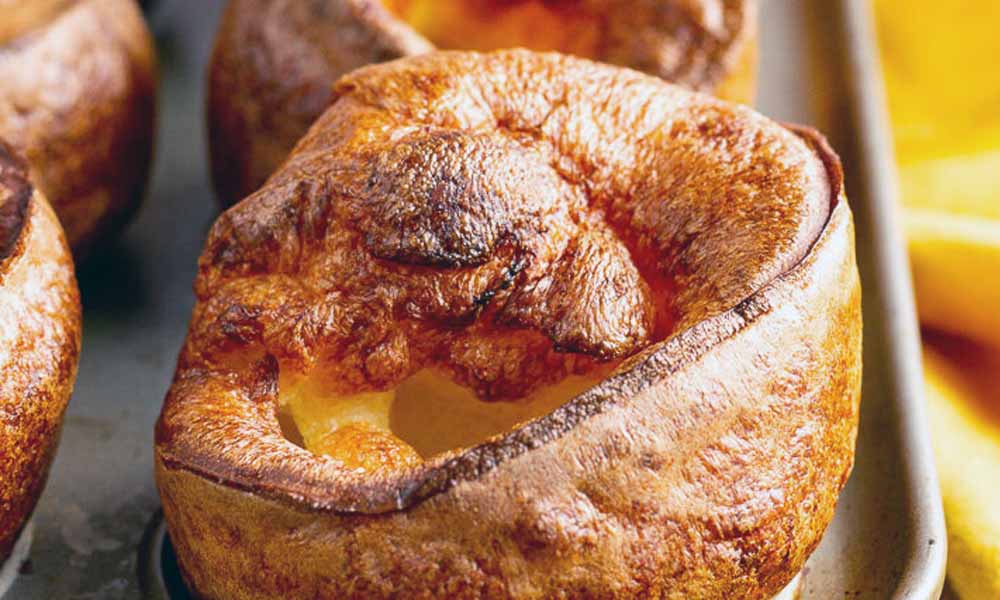
BEVERLEY – Few dishes are as bound up with Yorkshire’s identity as the humble pudding. Golden, risen, crisp at the edges but soft in the middle, it has been part of the county’s Sunday ritual for centuries. Yet what makes a perfect Yorkshire pudding remains the subject of as much debate as football loyalties or the correct way to make a cup of tea.
The first known recipe dates back to the 18th century, when cooks made a batter of flour, eggs and milk to stretch out the meat juices dripping from a spit. Over time the Yorkshire version became defined by its lofty rise — a culinary sleight of hand that turned thrift into pride. Today it is inseparable from the roast beef dinner, though many families insist it belongs with every roast, whatever the meat.
So what makes the difference between a pudding that soars and one that sulks in the tin? The rules, passed down through generations, are deceptively simple. The batter should be light, well rested and poured into tins that are not just hot but smoking. A good pudding is about confidence: once in the oven, the door stays shut. Timing, temperature and trust are the cook’s only allies.
Arguments continue. Should the batter be mixed smooth or left slightly lumpy? Is beef dripping essential, or will vegetable oil do? Must the puddings be vast plate-fillers, as in Yorkshire’s traditional inns, or individual cups that sit neatly beside the meat and potatoes? Purists will always argue for dripping and size, but home cooks find their own way.
Part of the magic lies in their versatility. Leftovers can be filled with stew, used for toad in the hole, or even treated as a dessert with syrup or jam — a reminder of their origins as an economical filler. They are, in their way, as adaptable as the county that gave them their name.
Perhaps that is why the Yorkshire pudding endures. It is not just food but a symbol of warmth, thrift and ingenuity. The perfect pudding is as much about memory as measurement: the smell of the oven on a Sunday, the comfort of a plate that feels like home, and the pride in something that is ours. Whether it towers sky-high or simply comes out crisp and golden, perfection is in the eating — and in Yorkshire, that is more than enough.
Recipe for the perfect Yorkshire pudding
Makes: 12 small (muffin tin) or 1 large tray
Time: 10 mins prep + 30 mins rest + 20–35 mins bake
Ingredients
- 200g plain flour
- 4 large eggs
- 250ml milk (or 200ml milk + 50ml cold water for extra lightness)
- 1 tsp fine salt
- 2–3 tbsp beef dripping (best) or rapeseed oil
Method
- Whisk flour and salt. Make a well, add eggs, then whisk in milk (and water if using) until smooth, the consistency of single cream.
- Rest the batter at least 30 minutes at room temperature (or up to 24 hours in the fridge).
- Put ½ tsp dripping/oil into each muffin hole (or 2–3 tbsp in one large tin). Heat in a 230°C (210°C fan) oven until the fat is shimmering and just smoking.
- Re-whisk the batter. Pour quickly into the hot fat (each hole two-thirds full).
- Bake — small puds 20–25 mins, one large tin 25–35 mins. Do not open the oven door early.
- Serve immediately, lifting to a wire rack for 1–2 mins before serving to keep the bottoms crisp.
Tips for success
- Resting the batter relaxes gluten and traps air → taller rise.
- Fat must be smoking hot → instant lift and crisp edges.
- Batter should be thin (like single cream), not thick.
Troubleshooting
- Flat: oven/tin not hot enough, batter too thick, no rest.
- Soggy bottoms: tin overfilled, oven too cool, left to steam in the tin.
- Dense: too much flour, under-rested, or oven opened early.
Variations
- Toad in the hole: brown sausages first, then add batter.
- Gluten-free: swap flour for a GF blend, add ½ tsp xanthan gum.
- Dairy-free: oat milk + 1 tbsp oil in the batter.
- Giant sharing pudding: use a 20–24cm ovenproof pan with 2–3 tbsp dripping.
Reheat & freeze
- Reheat at 200°C for 5–7 mins.
- Freeze up to 1 month; reheat from frozen at 200°C for 8–10 mins.